PSBT and transactions
UTXO applications should construct transactions carefully, request a signature through Pali, and broadcast only after the user approves.
Sign a PSBT

UTXO • Syscoin
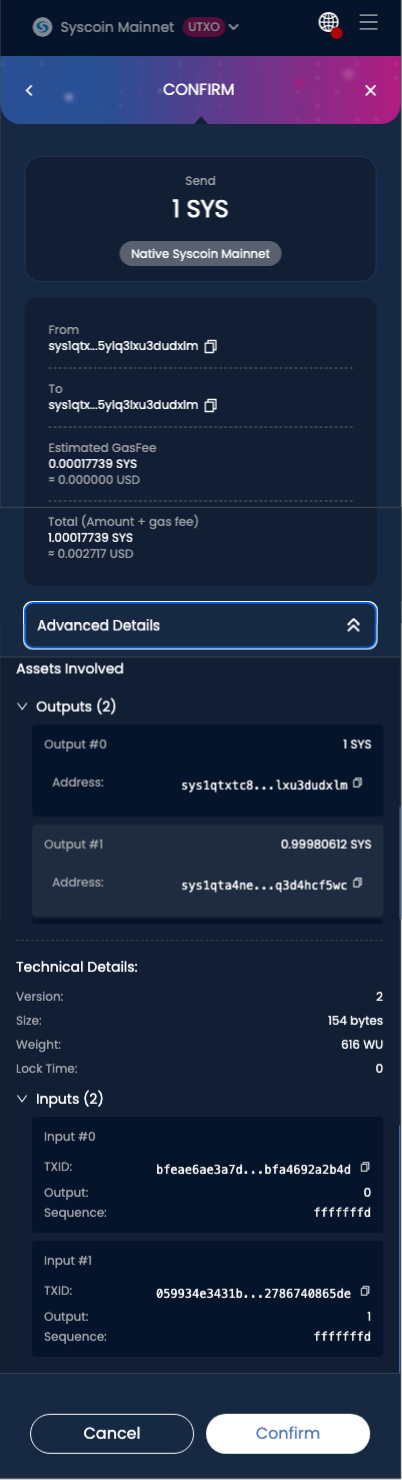
PSBT Sign Review
UTXO signing confirmation
Scroll inside the preview to inspect outputs, inputs, size, weight, and lock time.
const signed = await window.pali.request({
  method: 'sys_sign',
  params: [psbtBase64],
});
Sign and send
const txid = await window.pali.request({
  method: 'sys_signAndSend',
  params: [psbtBase64],
});
Fetch transactions
const transactions = await window.pali.request({
  method: 'sys_getTransactions',
});

const tx = await window.pali.request({
  method: 'sys_transaction',
  params: [txid],
});
Validate an address
const valid = await window.pali.request({
  method: 'sys_isValidSYSAddress',
  params: [address],
});
Dapp responsibility
Pali signs what the user approves. Your application is responsible for constructing sane PSBT inputs, outputs, fees, change, and asset metadata before requesting a signature.
Account selection
Signing is bound to the account connected to the requesting dapp and the approved network. PSBT metadata cannot select another wallet account. If Pali is displaying a different account, it can ask the user to switch to the connected account before approval. To use another account, change the dapp connection and request a new approval.
For a PSBT with unfinished inputs, at least one unfinished input must belong to that approved account. Pali signs only that account's inputs. Shared and multisig transactions can therefore return partially signed; other participants must complete their own inputs or signatures. Existing external signatures and supported finalized inputs are preserved. A completely finalized PSBT can be returned without adding signatures. Hardware-wallet support still depends on the device and transaction format.
A change of account or network invalidates the pending signing context. Rebuild or recheck the request and obtain a fresh approval instead of replaying the old request.